


Material Innovation in the CAD/CAM Era: A New Standard for Chairside P…
페이지 정보

본문
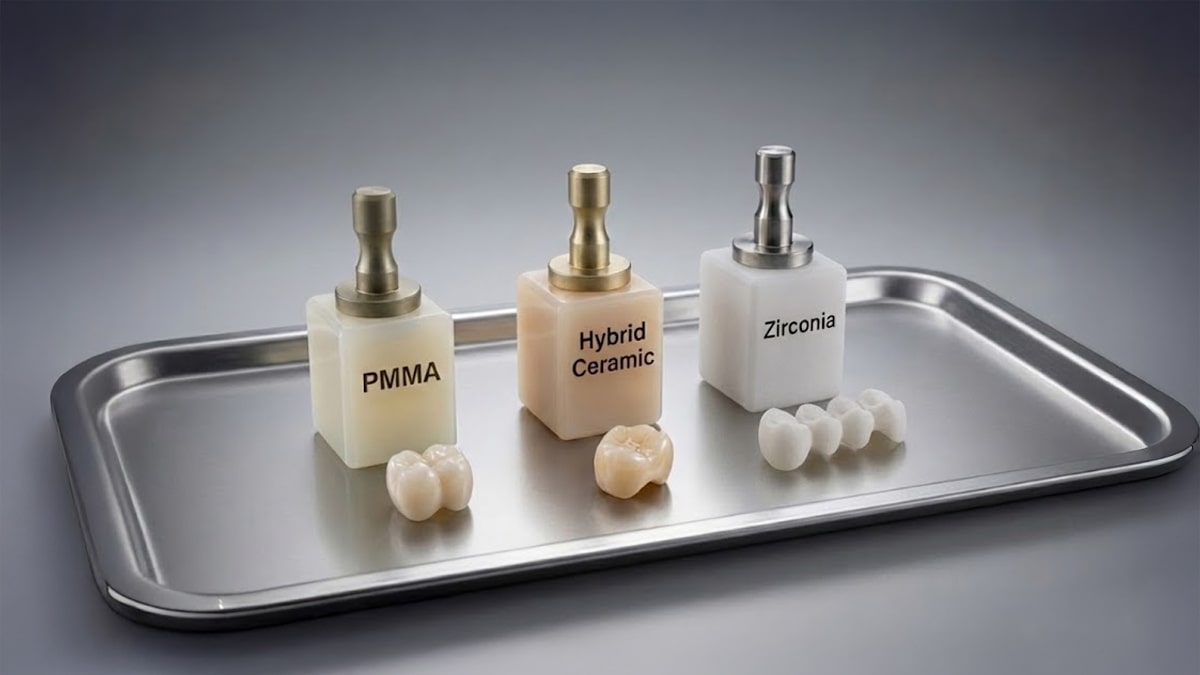
As the digital workflow becomes central to modern dentistry, restorative fabrication methods are undergoing rapid transformation. Traditional procedures—taking conventional impressions, sending cases to the laboratory, and delivering the final prosthesis days later—are quickly being replaced. With the integration of intraoral scanners, CAD design systems, and high-speed milling and 3D-printing units, true chairside restorations completed in a single visit have become a clinical reality. At the core of this transition lies not only advanced equipment but also a new generation of materials engineered specifically for digital production. PMMA, hybrid ceramics, and next-generation zirconia each offer unique advantages and limitations that collectively expand the precision, stability, and scope of chairside dentistry.
1. PMMA — From Provisional Restorations to Immediate Chairside Solutions
PMMA is a pre-polymerized acrylic resin known for its fast milling speed and minimal post-processing steps, which makes it one of the most widely used materials in chairside environments. Its low porosity during fabrication enhances fit accuracy, and its cost-effectiveness makes it ideal for provisional restorations.
PMMA is extensively used for temporary crowns and bridges, supporting rapid workflow adjustments during the treatment sequence. Its favorable mechanical performance also contributes to high patient satisfaction, especially in immediate chairside situations.
When utilized as CAD/CAM milling blocks, PMMA demonstrates excellent machinability and adaptation. Studies show that CAD/CAM-fabricated PMMA provisional restorations offer superior flexural strength, surface hardness, and surface smoothness compared to conventionally fabricated temporaries. Due to its biocompatibility, lightweight structure, and ease of adjustment, PMMA has long been used in denture bases, temporary crowns and bridges, and provisional implant restorations. Its clinical utility continues to expand within digital workflows.
2. Hybrid Ceramics — Balancing Esthetics and Efficiency
Hybrid ceramics were developed to bridge two material worlds: the esthetic stability of traditional ceramics and the flexibility and ease of processing found in resin composites. A recent 2025 review on CAD/CAM restorative materials highlights hybrid ceramics as clinically significant options for chairside dentistry due to their broad applicability and strong mechanical performance.
PICN (Polymer-Infiltrated Ceramic Network) materials and filler-dispersed resin–ceramic blocks exhibit elastic modulus and shock absorption properties similar to natural enamel and dentin. This allows them to closely replicate the biomechanical behavior of natural teeth.
Many hybrid ceramics require no sintering or only minimal post-processing, making them ideal for the streamlined “mill → polish → seat” chairside workflow.
With their balance of esthetics, efficiency, and functional performance, hybrid ceramics are a promising choice for anterior esthetic restorations as well as onlays, inlays, and veneers—all areas where chairside productivity can be maximized.
3. Next-Generation Zirconia — High Strength, High Esthetics, and Ultra-Fast Sintering
Zirconia has long been valued for its polycrystalline structure, exceptional flexural strength, and fracture resistance, making it a preferred option for posterior crowns and bridges. The arrival of CAD/CAM technology has made zirconia fabrication more precise and predictable than traditional ceramic methods.
Recent material science advancements have introduced high-translucency zirconia with improved esthetics and “fast-sintering” blocks capable of dramatically reducing sintering time. According to recent reports, zirconia has now reached an esthetic level suitable even for anterior single crowns.
Some manufacturers also offer workflows that make it possible to mill → sinter → deliver a zirconia crown within a single appointment—an achievement once considered impossible.
Zirconia remains unmatched in strength and durability. However, several considerations remain essential:
Zirconia cannot be etched like glass ceramics, so adhesion requires specialized surface treatments (e.g., sandblasting, primers). Its high hardness may cause antagonist wear, especially against natural teeth, necessitating careful occlusal planning.
Thus, next-generation zirconia serves as a high-performance material capable of delivering permanent chairside restorations. Successful outcomes, however, depend on thoughtful adhesive protocols, occlusal design, and accurate assessment of opposing dentition.
Sintered zirconia blocks from Vatech Mcis are provided in a pre-sintered—or fully sintered—state, enabling direct delivery without an additional sintering cycle. This significantly shortens chairside workflow time. Although fully sintered zirconia is extremely hard and more difficult to mill, the Lilivis MILL compensates with optimized toolpaths, spindles, and bur configurations designed specifically for high-strength zirconia.
4. Innovation in Chairside Productivity — Where Materials Meet Digital Technology
PMMA, hybrid ceramics, and next-generation zirconia are each optimized for specific clinical purposes. When combined, these three material pillars greatly enhance the stability and sophistication of chairside restorations.
PMMA provides speed and flexibility for immediate or provisional cases.
Hybrid ceramics offer a balanced blend of esthetics, function, and efficient processing.
Zirconia enables permanent restorations within a single visit.
All three materials rely on CAD/CAM-based fabrication, maintaining a consistent digital data flow from scanning to design. The adoption of chairside systems represents more than just improved turnaround time—it enhances marginal adaptation, supports minimally invasive dentistry, and expands patient-specific design capabilities.
Recent studies consistently report excellent marginal fit and clinical reliability in CAD/CAM-based restorations, reinforcing their position in modern dentistry.
5. A New Clinical Standard Driven by Material Innovation
Material innovation is reshaping the fundamental paradigm of restorative dentistry. PMMA delivers speed and adaptability within the chairside workflow, hybrid ceramics provide esthetic and functional balance, and advanced zirconia makes single-visit permanent restorations feasible. Together, these materials expand the clinician’s decision-making spectrum and establish new standards for precision, patient experience, and clinical efficiency.
Digital dentistry is no longer defined merely by fast fabrication—it represents an integrated ecosystem where the right material, the right digital design, and the right production method converge seamlessly. Because each material has distinct strengths, accurate diagnosis and individualized treatment planning become even more essential, directly improving clinical outcomes.
To realize this integrated workflow in practice, clinicians need a platform that reliably connects scanning, designing, fabricating, and seating.
Lilivis, with its SCAN → CAD → PRINT → MILL full digital workflow, provides an environment where materials such as PMMA, hybrid ceramics, and zirconia can be naturally incorporated into clinical strategies.
As material innovation continues to merge with digital technology, Lilivis stands as a clinical partner that brings these advancements into everyday dentistry—here and now.
[Reference]
- Ille, Codruţa-Eliza, et al. "Exploring the properties and indications of chairside CAD/CAM materials in restorative dentistry." Journal of functional biomaterials 16.2 (2025): 46.
 Inquiry