


The Future of Digital Dentistry Enabled by OCT-Integrated Scanners
페이지 정보

본문
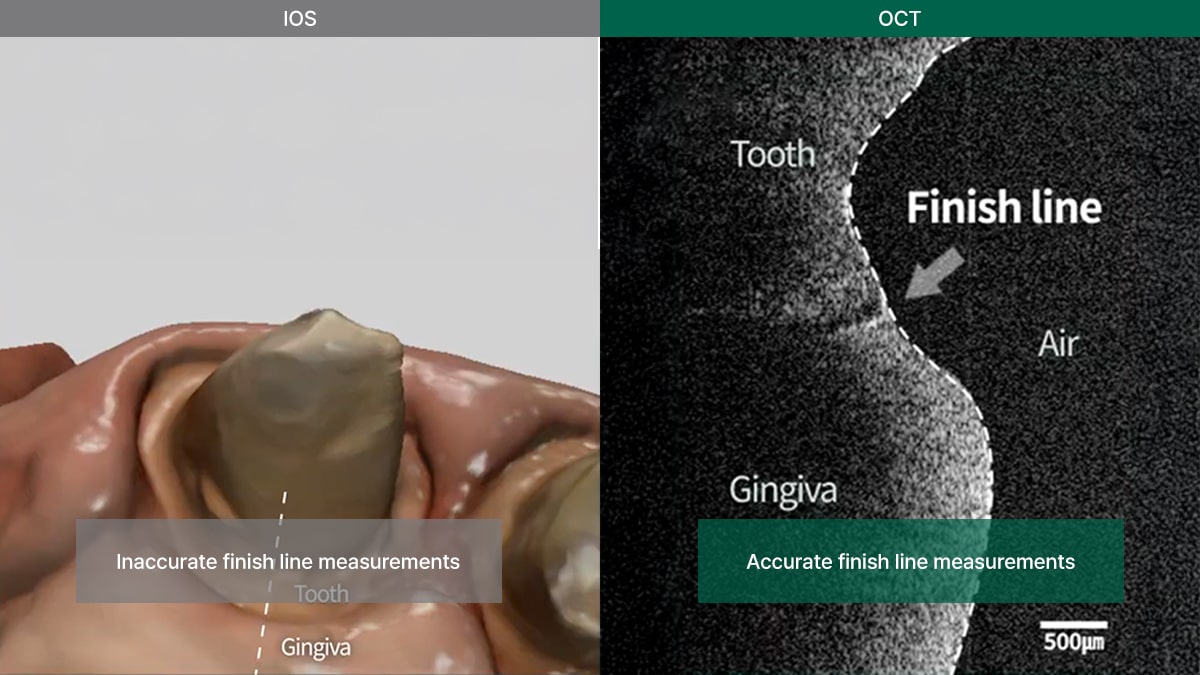
The accuracy of dental diagnostics is one of the most critical factors determining treatment quality. However, traditional diagnostic methods come with several limitations—radiation exposure, difficulty detecting early-stage lesions, and increased patient fatigue during repeated examinations.
In this context, Optical Coherence Tomography (OCT)—a radiation-free, high-resolution imaging technology capable of visualizing the internal structures of teeth—has gained significant attention. Recently, the emergence of OCT-integrated intraoral scanners has opened a new frontier in digital dentistry.
The Principles of OCT and Its Diagnostic Value in Dentistry
OCT is an optical imaging technique that reconstructs cross-sectional tissue images by analyzing the interference patterns of near-infrared light. It provides real-time images with approximately 10–20 μm resolution and is non-invasive, involving no radiation exposure—making it highly patient-friendly.
While traditional X-ray or CBCT imaging is effective for identifying larger structural changes, it often struggles to detect subtle features such as micro-cracks or early caries. In contrast, OCT can precisely capture the internal structures of both hard and soft dental tissues, offering significant advantages in identifying early lesions, micro-leakage, and cracks.
According to research by Hsieh, Yao-Sheng, et al. (2013), OCT can visualize pulpal conditions, restoration margins, and surface structural changes, and is highly effective for monitoring caries progression. These capabilities enhance diagnostic accuracy across restorative, prosthodontic, endodontic, and periodontal fields.
The Emergence of OCT-Integrated Scanners and Expanded Diagnostic Possibilities
Next-generation OCT-integrated scanners combine conventional surface scanning with OCT-based internal cross-sectional imaging. This dual acquisition within a single device is highly meaningful—it allows clinicians to obtain both external morphology and internal structural data simultaneously.
Surface-level information such as tooth shape, wear, and occlusion is captured alongside internal data showing pulp conditions, internal cracks, and marginal changes in restorations. This fusion enables clinicians to construct a far more precise digital twin of the patient’s dentition.
This integrated dataset enhances prosthetic design accuracy, improves restoration fit evaluation, facilitates early lesion detection, and supports evidence-based decisions for minimally invasive treatment. As digital workflows become more consistent and data quality improves, OCT-based systems may accelerate the shift toward Same-Day Dentistry and long-term monitoring models.
OCT Data as the Foundation for AI-Driven Automated Diagnostics
Because OCT reproduces internal structures in detailed 3-dimensional micro-resolution, it becomes an extremely powerful analytical tool when combined with AI.
Deep-learning algorithms can automatically detect micro-cracks, early caries, pulpal degeneration, and marginal leakage in restorations. AI can also build predictive models for lesion progression using accumulated patient data.
In medical imaging, AI-based layer segmentation, noise reduction, and automated boundary detection for OCT data have already been validated. Similar trends are expected to expand rapidly in dentistry.
The integration of AI and OCT enhances diagnostic consistency, reduces clinician-dependent variability, and enables quantitative patient communication—strengthening trust and promoting data-driven clinical decision-making.
A Catalyst for Industrial, Policy, and Clinical Paradigm Shifts
OCT-integrated scanners are poised to reshape dental care in several ways:
- 1. Strengthened early detection and prevention-focused care, reducing long-term treatment burden. Patients benefit from radiation-free, repeatable examinations, increasing both safety and satisfaction.
- 2. The emergence of radiation-free, high-precision diagnostic devices may trigger new discussions in insurance and regulatory systems, potentially allowing OCT to be classified as an auxiliary diagnostic tool supporting long-term prognosis management.
- 3. In the global digital dentistry market, OCT-based diagnostics may become one of the next-generation standards—impacting education, clinical protocols, and equipment selection criteria.
- ▪️Surface Scan Initiation – Captures tooth morphology, occlusion, and wear patterns in 3D
- ▪️Simultaneous OCT Scan – Acquires internal cross-sectional images (10–20 μm resolution) along the same path
- ▪️OCT + 3D Mesh Fusion Output – Visualizes internal cracks, early lesions, and marginal leakage in real time
- ▪️AI-Compatible Data Export – Enables automated lesion detection and longitudinal tracking
- Hsieh, Yao-Sheng, et al. "Dental optical coherence tomography." Sensors 13.7 (2013): 8928-8949.
A New Diagnostic Ecosystem Powered by OCT-Integrated Scanners: Introducing Huvitz OCTiX
OCT-integrated scanners represent a next-generation imaging technology that simultaneously captures the tooth’s surface geometry and internal cross-sectional structures without radiation. From early caries and micro-crack detection to improved prosthetic design accuracy and long-term monitoring, they are transforming the entire digital dental workflow.
As high-resolution scanning, non-invasive diagnostics, and AI-based analysis converge, digital dentistry is rapidly shifting from a treatment-centric model to a prevention- and prediction-driven paradigm.
Huvitz, with more than 30 years of precision optical engineering, is a global leader in ophthalmic optics and ranked among the world’s top three in this field. Leveraging its proprietary OCT, optical sensor, and imaging platform technologies, Huvitz is pioneering the application of OCT to dentistry—its flagship innovation being the OCTiX Intraoral OCT Scanner.
The Huvitz OCTiX provides simultaneous acquisition of external intraoral scan data and internal OCT cross-sectional imaging. During scanning, OCT layers are naturally mapped onto the surface mesh, creating a unified 3D digital twin of the tooth.
OCTiX Scanning Workflow
This technology was first unveiled at IDS 2025 in Cologne, drawing significant attention from global buyers, research institutes, and universities. Collaborative research requests for OCT-based digital diagnostics continue to grow worldwide.
Huvitz is preparing global distribution of OCTiX through its partnership with Ossvis, expanding access to this transformative technology.
If you need more detailed information about OCT-integrated scanners, feel free to reach out anytime.
 Inquiry